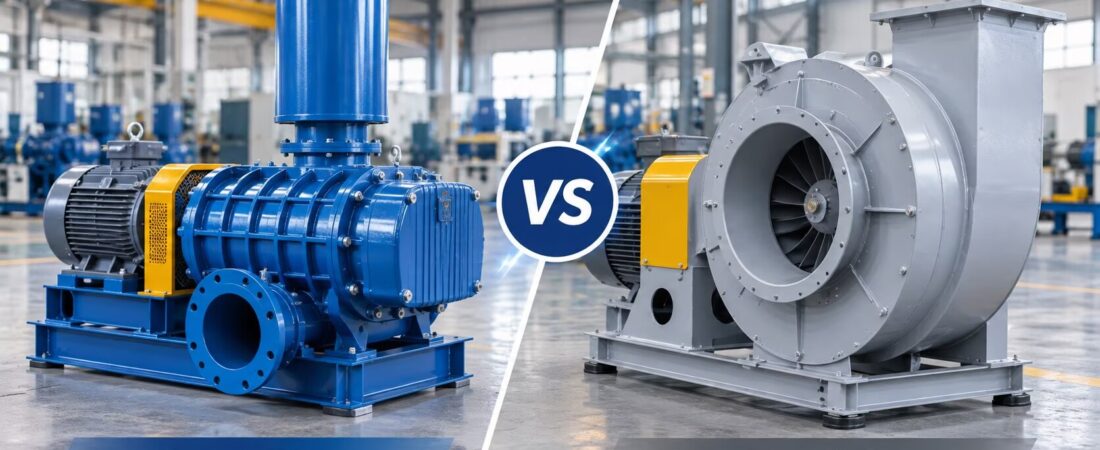
Roots Blower vs Centrifugal Blower is an important comparison when selecting an industrial air system. Both types of blowers are widely used in wastewater treatment, pneumatic conveying, aquaculture, and industrial processes, but they operate on different principles and provide different airflow and pressure characteristics. Understanding these differences can help you select a suitable blower based on airflow, pressure, energy efficiency, operating conditions, and application requirements.
What Is a Roots Blower?
A Roots blower is a positive displacement blower that uses two synchronized rotors to move a fixed volume of air or gas from the inlet to the outlet. One of its main characteristics is relatively stable airflow even when system pressure changes. Roots blowers are commonly used in wastewater aeration, pneumatic conveying, aquaculture, and other industrial applications that require continuous and reliable air supply.
What Is a Centrifugal Blower?
A centrifugal blower uses a high-speed rotating impeller to accelerate air or gas and convert velocity into pressure. Unlike a Roots blower, its airflow is more closely related to system resistance and the operating point. Centrifugal blowers are commonly used in wastewater treatment, industrial ventilation, process air systems, and applications requiring large and continuous airflow.
Roots Blower vs Centrifugal Blower: Key Differences
| Feature | Roots Blower | Centrifugal Blower |
| Working Principle | Positive displacement | Dynamic compression |
| Airflow | Relatively stable with pressure changes | Varies with system resistance |
| Pressure | Suitable for low-to-moderate pressure applications | Depends on blower type and operating point |
| Efficiency | Reliable across varying operating conditions | High efficiency near the design point |
| Maintenance | Simple and robust structure | Requires more precise components |
| Applications | Aeration, pneumatic conveying, aquaculture | Aeration, ventilation, process air |
Factors to Consider When Selecting a Blower
When comparing a Roots Blower vs Centrifugal Blower, the required airflow and pressure are two of the most important factors. The blower should be selected according to the actual system resistance, operating pressure, airflow demand, and expected operating range. For more information about industrial fan system efficiency, refer to the U.S. Department of Energy’s Fan Systems resources.
The application also affects blower selection. For wastewater treatment, factors such as aeration depth, airflow demand, system resistance, and operating hours should be considered. For pneumatic conveying, conveying distance, material characteristics, pipeline resistance, and required conveying capacity are important parameters.
Energy consumption, maintenance requirements, installation conditions, noise level, and initial investment should also be evaluated. Providing accurate operating parameters allows the blower manufacturer to recommend a more suitable model and configuration for the system.
Which Blower Should You Choose?
Choose a Roots Blower when your system requires relatively stable airflow under changing pressure conditions. Roots blowers are commonly used for wastewater aeration, pneumatic conveying, aquaculture, and other applications requiring reliable and continuous air supply.
Choose a centrifugal blower when the system requires large airflow and efficient operation near the designed operating point. Centrifugal blowers are commonly used for wastewater treatment, industrial ventilation, process air systems, and other applications requiring continuous airflow.
Conclusion
Both Roots blowers and centrifugal blowers are widely used in industrial air systems, but they have different operating characteristics. When comparing a Roots Blower vs Centrifugal Blower, the final selection should be based on required airflow, pressure, operating range, energy efficiency, and application conditions. Qingsheng Blower can recommend a suitable blower solution according to your actual operating parameters and application requirements.
Frequently Asked Questions (FAQ)
1. What is the main difference between a Roots Blower and a Centrifugal Blower?
A Roots Blower uses positive displacement to deliver relatively stable airflow, while a centrifugal blower uses a high-speed impeller to generate airflow and pressure. Their performance characteristics make them suitable for different operating conditions and applications.
2. Which blower is suitable for pneumatic conveying?
Roots blowers are commonly used for pneumatic conveying because they can provide relatively stable airflow under changing system pressure. The final blower selection should be based on conveying distance, required airflow, pressure, material characteristics, and pipeline resistance.
3. How do I select the right blower size?
To select the right blower size, please provide the required airflow, operating pressure, application, conveyed medium, and operating conditions. For pneumatic conveying applications, conveying distance and material characteristics are also important. Qingsheng Blower can recommend a suitable model based on these parameters.